The Bishop Gallery is dedicated to my Great-Grandfather Frank Bishop who served in the Kings Own Yorkshire Light Infantry and the Royal Warwickshire Regiment between 1914 and 1918. Grampe’s wartime photos is one of the main reasons I started my photo restoration work and it thus feels very fitting to dedicate this gallery of my First World War work centred around the Western Front in his name.

The Great War (1914-1918)
Originating as a crises in the Balkans, the Great War as it came to be known rapidly developed following the breakdown of diplomatic relations across Europe in the late summer of 1914. The spark had come on the 28th June as the heir to the Austro-Hungarian Empire, Franz Ferdinand, was murdered by a 19 year old Serbian Nationalist in Sarejevo.
Europe had survived numerous diplomatic crises throughout the 1900s and 1910s, but for the Austro-Hungarians the murder proved a perfect justification for a manufactured war against Serbia. A humiliating ultimatum, designed to be rejected, was sent to Serbia’s finance minister on the 23rd July. Its dismissal two day’s later came to none of Vienna’s surprise as within hours Belgrade is being shelled and the war in the Balkans begins to unfold.
What ensues is a domino effect, as one by one other countries who have either promised neutrality or are honour-bound to defend legal and cultural allies begin to declare war on other European nations. Very quickly a diplomatic crisis has engulfed much of the world and by mid-August these diplomatic avenues have closed. From then on, the Triple Entente made up of Britain, France and Russia are spiralled into fighting the German, Ottoman and Austro-Hungarian Empires which make up Triple Alliance. European nations are not the only to be sucked into the conflict as colonial powers are quickly used for means of labour and manpower; bringing the fighting to Africa, the Middle East and Asia.
By 1918, the war has mutated into something unrecognisable to that of the summer of 1914. 65 million people have been mobilised for the fighting which as a result, its believed at most 11 million servicemen are killed, a further 13 million civilians as well as 8 million horses. The war which was believed would not go any further than January 1915 has heralded in a new age of mechanised conflict as well as a political renaissance that would set precedence for the rest of the century.

The Western Front
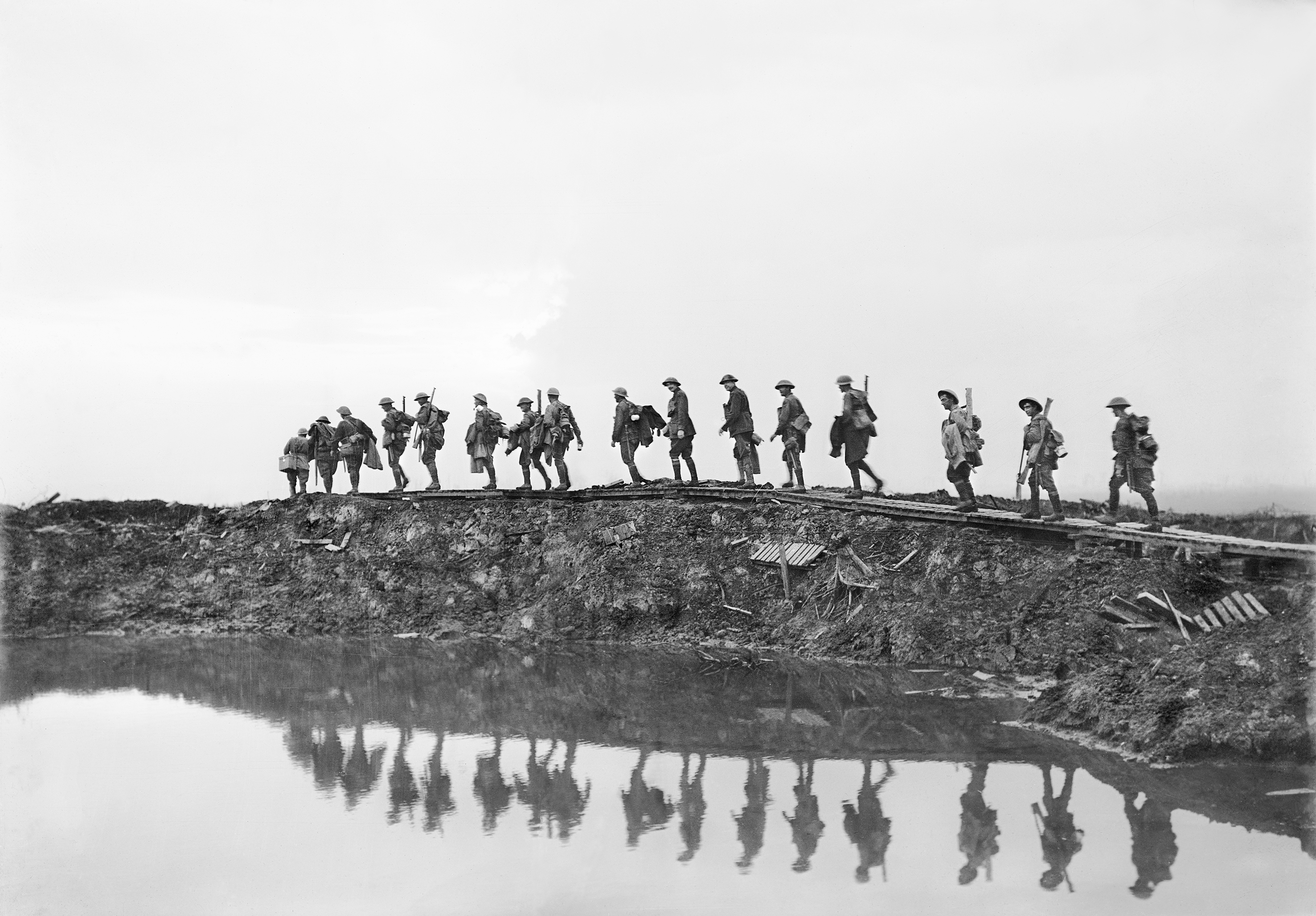
The Western Front for the most part describes the 450 miles of interlocking trench network systems that peppered most of Northern France and parts of Southern Belgium for the continuation of the war.
Upon official outbreak in August 1914 vast armies broke out across the French countryside as the German Army attacks neutral Belgium and the Ardennes Region in an effort to surround the French Army as well as capturing Paris in what is called The Schlieffen Plan. France in response initiates Plan XVII, a disastrous attack into the German Rhine. The French Army in disarray is thrown back across the border and a general retreat begins as the German Army now almost ungoverned in the chaos storms across France. Britain obliged by the Treaty of London (1839) to defend Belgium, lands an Expeditionary Force that August, but its small professional army are overwhelmed and quickly beaten back at the Battles of Mons and La Cateau, joining their French counterparts in fighting a bitter rearguard action during the general retreat.
The German Army though bearing significant success is wrought with logistical issues and a continuing unrested army; they are halted then at the Battle of the Marne, just 40 miles north of Paris. From here, each side attempts to tactically out flank one another throughout September and October, in what would be known as the Race to the Sea; with each side continuing to skirmish their way to the English Channel; this would be the last period of manoeuvrability on the Western Front until the German Kaiserschlacht in March 1918.

The line halts at Nieuport on the Belgian coast just to the north of Calais and both sides dig in for the winter. Trench warfare has begun. Across the next four years British, French, Belgian, American (post-1917) and Colonial Powers are dug in facing the Germans. The Entente are forced onto the back-foot, having to find the best way possible to dislodge the invaders; this is often in costly offensives which produce a proportionately high number of casualties. The Germans understand their advantage and adopt a hold out policy by entrenching themselves in sophisticated networks that protect them to better extent than the trenches of their Anglo-Franc counterparts.
The Trenches
Trench warfare would be used in all theatres of the conflict to some extent. The gruesome and prolific nature of it on the Western Front however becomes both synonymous as well as symbolic to the bloodshed and relentlessness that which epitomises the Great War.
Men are not just tormented by the enemy, but by sickness and the landscape which at the start of the war rapidly diminishes into a wasteland of shell-holes and gut-wrenching decay as bodies are continuously lost to the mud which plagues No-Man’s Land (the killing zone between the trenches).
