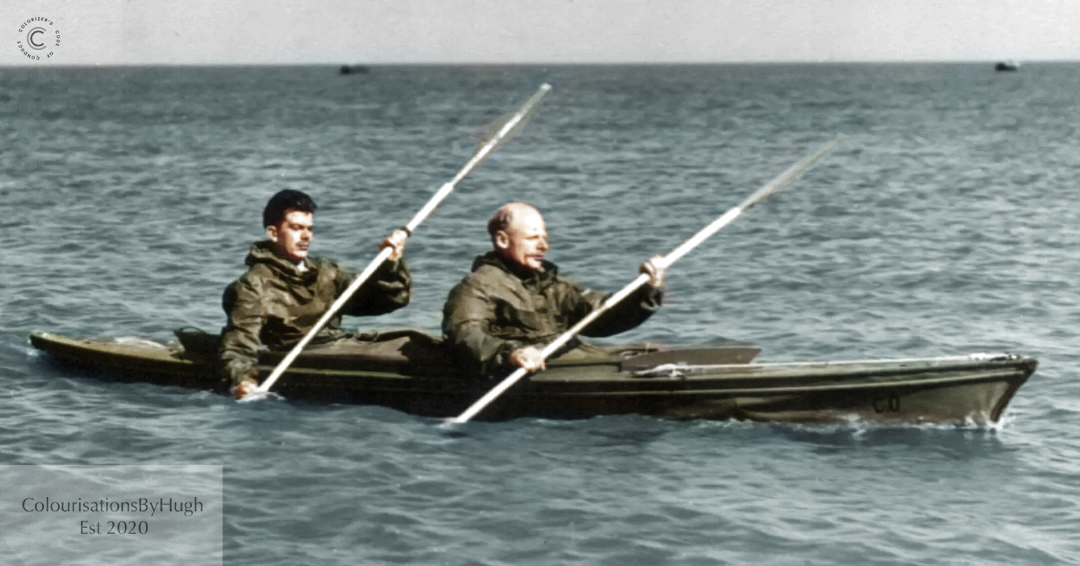
It was 19:17 on 7th of December 1942, the waters of The Bay of Biscay were uncharacteristically calm and illuminated with great clarity by starlight. It was the last night for at least a week the waters in and around Bordeaux would be illuminated by lunar light. HMS Tuna, a T-Class submarine, was about to emerge from the depths, tasked with the partaking of a heavily audacious plan to infiltrate German Occupied Europe and set it ablaze. The calm conditions probably worked unfavourably to the submarine’s inconspicuousness, and any sign of making contact with the Germans likely would have led to an abandonment of the operation.
Nevertheless, “beastly clear” the Commanding Officer, LtCdr. Dick Raikes, remarks as the decks of the Tuna are alive with Royal Marine Commandos assembling their Cockleshell Canoes, “looks all right for your launching. Do you want to start?” Replying to this is 28 year old Acting Major Herbert ‘Blondie’ Hasler: ‘yes, it is time to go’. Operation Frankton was truly about to begin.
Operation Frankton stands as legacy to Britain’s clandestine operations in Europe during a time when the war looked to be at its darkest. It represents all that embodies the British wartime spirit, that of tenacity, ambition, survival and endurance. It’s hoped this recantation based heavily off the book ‘A Brilliant Little Operation‘ by Paddy Ashdown can serve as a worthy tale tell as to why this operation should be thought of when we think to ourselves what it is to embody the human spirit in times of peril. All that which follows begins with Hasler.
Herbert ‘Blondie’ Hasler
Hasler is an incredibly unique figure in British history. Born in Dublin in 1914 he was ultimately raised in the dockyard city of Portsmouth having emigrated with his mother Annie after the death of his father in 1917. They resided on the Southsea Solent for the remainder of his childhood, ‘Bert’ grew up as a keen sportsman, though retained social timidity. He was an avid outdoorsman; passionate about the sea and sailing. Resourceful and intelligent, in 1926 he constructed his own two-seater canoe through a set of instructions found in an edition of ‘The Boys Own Paper’. Leaving primary education, in 1927 he attends Wellington College in Berkshire. He becomes a bit of a target to ridicule on account of his Portsmouth dialect, which may be why he naturally took a lot of time to warm up to people later on in life.
Finishing education in 1932, he chooses to commission into the Royal Marines which offered better pay than the Royal Navy. His talents physically, charismatically and in intelligence come into their own throughout training as he is remarked as a highly effective candidate. He distinctly grows a blonde moustache, seemingly trading it off with the thinning hair atop his head, giving him his nickname which stuck for the rest of his life: ‘Blondie’. By 1940, Hasler is a landing craft commander based out of Scapa Flow in Scotland, he has conducted operations during the British Narvik Campaign in April with the French Foreign Legion, being awarded the Croix de Guerre and an Order of the British Empire as a result. In January 1942 he joins the Combined Operations Deployment Unit based out of Eastney Barracks in his childhood city of Portsmouth.

The Slump of 1942
1942 as described by Lucy Noakes was the ‘nadir’ of the war for Britain. Empirical security was being tested daily very close to home as the German Navy continued to publicly boast its battleship fleet in the English Channel and North Sea. Making matters worse, the underseas fleet was plundering food imports with unrestricted submarine warfare; causing heavy shortages of vital supplies throughout the year. Far flung, the empire had just lost Singapore that February to the Japanese, who now blitzed themselves across British Malaya. When Hasler begins the process of forming his ‘Royal Marines Boom Patrol Detachment’ in July 1942 which would conduct his raid, America was yet to get involved in the western war and Russia was at the height of its territorial loses as the Battle of Stalingrad was mere days from dawning. In short, the British public were desperate for any morale boost as a starving population isolated and alone saw little end to the war that had now raged for three years.
“It was [1942] one of the worst years in World War II, Great Britain’s fortunes were at a low ebb.” – Historian Major Mark Bentinck RM
The Legacy of the Commando
Under the banner of ‘Combined Operations’ as run by Louis Mountbatten, the Commandos were founded in the aftermath of the Dunkirk Evacuation and throughout the early-war years had been making a name for themselves amongst the British public as well as amongst the Axis. A consistent source of public morale, they had penetrated the French coast mere months after Dunkirk in Operation Collar and furthermore had conducted raids across Norway during spring 1941, notably Operation Claymore. Between 1940-1942 they consisted of elements of all land, sea and air forces from across the British Armed Forces, including foreign legion ‘troops’ from the occupied territories such as Poland, France, Germany, Holland and Belgium. By 1942, Royal Marine Infantry Battalions were also being transformed into Commando units, falling now under the legendary umbrella of Combined Operations. Whilst Operation Frankton as it came to be would not become public common knowledge until after the war, the indirect results via ‘word of mouth’ it yielded would have undoubtedly fed into British morale being bolstered in some capacity.
‘We need specially trained troops of the hunter class, who can develop a reign of terror down these coasts of occupied Europe, first of all on the butcher and bolt policy… leaving a trail of German corpses behind them.’ – PM Winston Churchill, 1940
The Royal Marine Boom Patrol Detachment (RMBPD)
Hasler first approaches Combined Operations in mid-1941 suggesting the use of canoes and demolition swimmers to attack shipping in harbours. The Admiralty initially rejected his plan given although it was extremely low cost, the risk to reward ratio was hard to accept, though it had definite potential. The decision to override this was possibly swayed after Italian ‘Frogmen’ Special Forces, the Decima Flottiglia, successfully albeit unknowingly replicated this plan in December 1941, incapacitating two battleships and a destroyer in the Port of Alexandria leaving them hors de combat. By the end of the year, Hasler is employed to find ways of replicating the methods of attack employed by the Italians now against enemy shipping. He is undeniably enthusiastic about developing the necessary means to achieve his objective. Hasler’s issue is that whilst he has been given a mandate to pursue covert operations, the task of replicating these same methods being employed by the Italians isn’t quite the experimental line of work he had in mind; so alongside his formal work he continues to experiment in secrecy with canoe construction and tactical refinement.
Throughout March 1942 he works with independent boatbuilders to create what will become his ‘Cockle’ line of canoe. He refines the models throughout most of May, and in June simultaneously starts to implement them alongside the port infiltration tactics he is now writing the playbook on. He enters Portsmouth undetected for the first time on the 4th of June in his ‘Cockle’ Mk.I; replicating the operation ten days later in his Cockle Mk.II. Logistically, he starts recruitment around this time, persuading Captain John Stewart RM to join him as his Second in Command. Stewart would become a much beloved member of the RMBPD, he served as a non-operational figure but was paramount to the logistical success of the operation, absorbing large amounts of the administrative responsibility. He was easy mannered, naturally commanding but above all else incredibly caring for Hasler’s Marines, earning him the nickname ‘The Old Man’.

Between the 25th of June and 1st of July, Hasler interviews ten second lieutenants, two sergeants, three corporals and twenty-eight marines; of which he selected two officers and twenty-nine men. This cohort of 33 men, himself and Stewart included, would go on to form ‘No.1 Section RMBPD’, formalised on the 6th of July. Only 13 men however in the end would physically be undertaking the operation.
Their training pipeline was incremental. They started as expected heavily centred around water activity as they spent days at a time in the Southsea Solent on exercise refining navigation, arduous weather training, diving, and light signalling in and around the Portsmouth waters. They progressed from boatmanship onto field and survival skills. This ‘green skills’ segment was augmented with an offensive set of skills as it focused on things like section attacks, ambushes, the taking of prisoners, silent disposal of the enemy; they were however heavily kept in date with seamanship currency alongside this training.
The Importance of Bordeaux
Hasler is first approached by the Admiralty on 21st of September where they offer him the target of Bordeaux. Bordeaux sits sixty-miles up the Gironde River from the coast bordering the Bay of Biscay; its importance cannot be understated. In this context, Germany has lost its Trans-Siberian connection to Japan and relies on this key deep water Atlantic port to reach the Far East. It achieves this via a network of ships known as blockade-runners who are fast enough to evade the danger of being sunk by submarines. Britain has been aware of this since the fall of France in 1940, and has made continuous attempts to incapacitate the port, with minimal effect being achieved. Special Operations Executive (SOE) had been suggesting for sometime a more covert approach may be needed, and thus Hasler and his new RMBPD were approached.
The Plan
Operation Frankton was mulled over through late September into early November, but Hasler originally came up with the idea for just three canoes and six men. They would be ferried by HMS Tuna (N94) from Helensburgh in Scotland to the drop off point in the Bay of Biscay; aiming to arrive just at the start of the lunar cycle on a new moon. Six commandos though this would be further augmented to twelve men would traverse the seventy-miles from the Bay of Biscay to Bordeaux during the nighttime flood tides. During the daytime, they would ‘lay up’ ashore, waiting for the next night to start the process again. Hasler calculated this process would take four days, and on account of the next lunar cycle starting on the 8th of December, would put him in Bordeaux for the 12th. He aimed to plant the demolition charges no later than 02:30 on the morning of 13th on a no less than three hour fuze, hoping to traverse partially back down the river seaward in the ebb tide in order to escape detection.
This article doesn’t withhold the scope to delve into the importance SOE held during the development of Operation Frankton. Comparatively, the integration of critical SOE infrastructure is arguably as paramount to the operation as the incapacitation of Bordeaux itself was valued to Britain’s war effort. MI9 between 1940 and 1942 had been developing a strong system to aid escaping prisoners of war from Occupied Europe via collaborative contacts within the French Resistance. One of these connections was the ‘Marie-Claire Line’ run by Mary Lindell which organised passage out of France via the Pyranees and into neutral Spain. Based out of Ruffec, situated ninety-miles north-east of Bordeaux this would be No.1 Section’s best chance of escape upon completion of the operation. If we consider however that throughout the entire war out of 170,000 allied escapees from German camps, only 1,200 would make ‘the home run’ back to friendly territory (which is approximately a 0.7% escape rate), and so even the best chances were astronomically unlikely.
The 13 Men of No.1 Section
Hasler organises No.1 Section in two divisions, Able and Baker, callsigning each two man canoe with a specific codename.
| ‘A’ Division | ‘B’ Division | Reserve |
| Catfish: Major Herbert Hasler & Marine Bill Sparks | Cuttlefish: Lieutenant John MacKinnon & Marine James Conway | Marine N. Colley |
| Crayfish: Corporal Albert Laver & Marine William Mills | Coalfish: Sergeant Samuel Wallace & Marine Robert Ewart | |
| Conger: Corporal George Sheard & Marine David Moffatt | Cachalot: Marine W.A. Ellery & Marine E. Fisher |
As stated perviously, Capt. Stewart was a predominant administrative Second in Command, who did not take physical part of the operation. The responsibility of Second in Command was thus handed down to Lt. John MacKinnon, who would lead ‘B’ Division.
Route of HMS Tuna (N94)
At around sunrise on the morning of the 30th of November 1942, HMS Tuna berthed outboard of three other T-Boats, entered into the ship’s log 13 passengers. By 10:30, the orders for ‘let go all lines’ was passed, and she began her circa 900 mile journey to Bordeaux. They have a practice launch in a disused firing range (likely in Loch Long) before stopping once more in HMNB Clyde. Following this, she rendezvouses with HMS White Bear at Garroch’s Head, who would escort her to the Scilly Isles but go no further.


The cramped 25ft long for’ard torpedo room would be their home, common room and operations centre for the next five days and nights. Hasler throughout this time is briefing his men on the operation, some of who assume they are going to Norway. He confers simultaneous with Raikes on Tuna’s movements as they meticulously try to plan where the dozen men would be cast into the Bay of Biscay. Around them claustrophobia was common if not only heightened as all thirteen of the men were stuffed into any space they could find along with their bountiful amounts of kit.
Offshore of the Gironde estuary Tuna is forced to undertake delaying evasive manoeuvres which would last until the late hours of the 7th of December. Pestering civilian fish trawlers (which had been inadvertently shadowing them since Talmont Saint-Hilaire around Point 6) and German patrol vessels were very active in the area and only increased the risk of detection. They were also being put on edge by the Luftwaffe who undertaking operations in and around Bordeaux, but these are risks they had to work in lieu of given the weather and lunar cycle stipulations. To make matters worse, the RAF had mined the waters around the entrance of the Gironde, which both the Commanding Officer, LtCdr Raikes nor Hasler knew where this belt was situated. Tuna was forced to inch further and further, slowly and silently to the final dropping point at the coordinates 45°22’01.0″N, 1°14’00.0″W arriving on the evening of the 7th of December as everyone held their breath awaiting the flash decompression of hitting a friendly sea-mine.
A German patrol vessel sat visibly four miles away from the Tuna but weather permitting Hasler couldn’t wait any longer, lest risk the entire operation. Across a forty-minute period Raikes continues with the launch of the cockles, using the deck gun as a makeshift crane to lower them into the Bay of Biscay. This was completed sometime between 20:15 and 20:35. On the transfer from below decks, Marine Ellrey and Marine Fisher’s cockle ‘Cachalot’ is snagged on a hatch clip, ripping a chasm in the hull. After pleading with Hasler and Fisher even being brought to tears having been denied the time to repair it Blondie’s decision is final. They must return to Britain onboard the Tuna with Marine Colley who sat in the reserve spot for the operation; little did they know, this decision likely saved their lives.
An Operation Underway – 7th of December 1942
Once launched, Hasler and his remaining five canoes began moving due north towards the mouth of the estuary as Tuna slips beneath the waves once more. They begin fighting the outgoing ebbing tide for approximately forty minutes until slack water at around 21:30 whilst avoiding detection from shore-side searchlights who had now been alerted to Tuna’s presence; we know at sometime around 23:50 the marines encounter a tide rip current. A rip current is created by two opposing current flows transgressing uneven seabed; Hasler decides it is best to navigate this patch of difficult water one at a time, of which himself and Bill Sparks go first.

One by one the canoes reemerge from the dark, but only four appear. Sergeant Wallace and Marine Ewart of ‘Coalfish’ have vanished into the night and fail to respond to any calls made by Hasler, who in vain makes his bird calls to the pitch black of the Atlantic waters fruitlessly returning no response. They wait until 00:15 (now the 8th of December) but pressed for time and as briefed in the torpedo room, the operation comes first; the now remaining four canoes must leave them behind.
Coalfish would paddle ashore, where Wallace and Ewart would be captured at the Pointe de Grave lighthouse upon daybreak. They claimed to be British sailors, but their identity as saboteurs was quickly uncovered with the discovery of their canoe, a map of Bordeaux and mines. Interrogation swiftly followed by the local intelligence services, who stayed their execution as ‘warranted’ under Hitler’s ‘Kommandobefehl‘ (Commando Order). Wallace revealed most of the conspiracy, but had tricked the Germans into believing he was the leader of the operation and thus it had been foiled. Having extracted all information they though necessary, the Germans took them to sandpit north of Bordeaux on the 11th of December where they were executed by firing squad.


After separation the remaining canoes paddled closer to the estuary, but soon encounter another tide rip. One by one they pass through again. Similarly to the last time only three emerge. Varyingly, Hasler need not make his bird calls as Corporal Sheard and Marine Moffat of ‘Conger’ are locatable when they cry out amidst their capsize. Thrown from their canoe which is now being drowned by lapping waves, Hasler deems the only way to save it would be to beach themselves and bail it out. It’s considered too large a risk, and now Hasler in ‘Catfish’ begins towing Sheard and Conger whereas Lieutenant MacKinnon and Marine Conway in ‘Cuttlefish’ takes on to tow Moffat.
After an hour they are approximately a mile away from shore at Le Verdon-sur-Mer. Hasler reluctantly tells Sheard and Moffat he must cut them loose bound by time yet again and they must swim to shore in order to escape overland. By this point they had been in the December waters for over an hour; this decision undoubtedly condemning them to their suspected hypothermic deaths. Understanding why, a grey and dying Sheard simply replies with words to the effect of “that’s alright Sir, thank you for bringing us so far”. They were never seen alive again, and Moffat’s body was only recovered having been washed ashore in Le Bois-Plage-en-Ré on the 17th of December; he was buried locally and still resides there today.


Shortly having parted with Conger now in the estuary mouth itself, the remaining three canoes encounter a patrol boat jetty which protrudes from a quay in Le Verdon. They decide a slender low profile would be safer than an en-masse crossing to navigate around it and one at a time go by. Catfish goes first, followed by Corporal Laver and Marine Mills in ‘Crayfish’. This time, it is Cuttlefish which doesn’t reemerge. Hasler bird calls to his third lost canoe, but once again to no avail. We don’t know the route MacKinnon and Conway laid up that night, but we do know they would follow the westbank to their objective, shadowing but never to link up with Hasler and his remaining men again.
The last two of the six canoes, Catfish and Crayfish continue on into the night. Such a plightful start to the operation has meant Hasler has not met the distance target he’d have wanted to by this point, which lay a further 25 miles upstream. He has however thought of this eventuality and has made preparations for lay up spots on this side of the estuary. He found his original chosen site to be too treacherous due to fishing stakes protruding out the water and did not want to risk damage to the canoes, so they paddle further down shore to a point known as Le Pointe aux Oiseaux. They arrive at sometime around 06:30 on the 8th of December having fought an ebbing tide since approximately 04:00 that morning.

Waining Luck – 8th-10th of December
The lay up point at Le Pointe aux Ouiseaux had provided sanctuary but had not come without considerable risk. The area was rife with German patrols which highlighted the importance of Bordeaux and were constantly roaming this stretch of the coastline.
The only people to find them much to their luck were a group of French fishermen from neighbouring St-Vivien-de-Merdoc that were wading the slack water mud for mussels. Throughout the day those who had discovered the crews of Crayfish and Catfish brought from their homes food and wine, promising not to expose them to the enemy; it was a promise much to their nerves which was firmly kept. Sunset on the 8th was at around 16:25, but ideal times to start paddling again wouldn’t come until the tide turned to flood at around 23:00, if they left at sundown as planned they would be battling the ebb throughout the evening which given they were already behind would have meant sapping energy they direly now needed to conserve.
Shy of midnight they set out into the middle of the sea lane evading a school of patrol boats who were now on high alert for saboteurs at the presence of both Tuna and the fact Wallace and Ewart were now in custody being interrogated by the authorities. The downstream flood carries them the remaining 25 miles to the intended original first day lay up point the banks of Braud-et-Saint-Louis now on the eastside, arriving sometime around 05:00 on the 9th of December.
I imagine this point in the operation was a bit of a ‘burn the ships’ feeling for Hasler. In serious arduousness his attacking force has been slashed by two-thirds by just the weather conditions. Hasler was not the kind of character to show his disdain visibly, and he knew being Frankton’s mastermind he couldn’t visibly show his emotional or physical weariness to his men; he often chose to suffer in silence and preferred to get on with the job at hand, privately basking in lament during its aftermath. There is now no turning back, a factor he is more than aware of when finally arriving at this lay up point.
His lay up point naturally sat in dense greenery on the banks of the Gironde near the hamlet of braud-et-Saint-Louis. he finds the place more than suitable, it importantly naturally conceals their canoes and provides good shelter for them throughout the day. Once again the only people to find them is a local man by the name of Alibert Decombes who after querying Hasler about wars end pleas with them all to come join him at his home. Tempting as is, Hasler denies the offer and only asks of him to keep their whereabouts in confidentiality; he does however promise to visit Decombes and his home after the war has ended.

They reside at Braud-et-Saint-Louis riverbank until around 18:45, and after difficulties launching their canoes followed by an additional 45 minute wait for the tide to turn, they progress further down the Gironde. Hard done by a close call with a patrol boat, the group was set back having to take shelter in the tall reeds of the île de Patrias archipelago isle. They relaunched in the early hours of 10th of December but struggle to gain distance in the ebb. They arrive just over ten miles upstream on the eastbanks of île Cazeau at around 06:30, unbeknown to the fact that Cuttlefish which had been making its way down the westbank had chosen to lay up on the same isle they were.

Within Sights: Bordeaux – 10th-11th of December
Words alone can’t describe how horrific the conditions at île Cazeau are that day, as Hasler, who is being harangued by patrol boats, is forced amidst rain and dew to keep his men mounted in their canoes amongst the riverbanks and slumped in low profile stress positions for the daytime of the 10th, unable to sleep and with little movement as to make no trace of human presence in the ever-growing busier waters closer to Bordeaux.
We know the banks of île Cazeau is also the lay up point for Cuttlefish. Upon launching at an unknown time that night on the 10th, they quickly however collide with a submerged object, which violently and rapidly scuttles their canoe. MacKinnon and Conway are briefly separated, but are undetected and importantly unhurt with their ready made escape kits. Their operation however was over, and their escape started here.
Rough Escape Kit List for Canoe Pairs
| Binoculars x1 | Needle and Thread x1 |
| Reading Torch x2 | Oil Bottle x1 |
| Matches Set x2 | Pencil Set x2 |
| Watch x1 | Pieces of String x8 |
| Benzedrine Boxes x1 | Water Sterilisation Set x2 |
| Field Dressing x2 | Toilet Paper Packet x2 |
| Morphia Syringe x2 | Camouflage Cream x1 |
| Foot Powder x1 | Iodine Bottle x1 |
| Tinned Water x2 | Rations Set x2 |
| Pill Box x1 | Canteen x1 |
At around 18:45 on the 10th of December Catfish and Crayfish launch. They are met with a welcomed two knot flooding tide which helps carry them swiftly upstream. Favourable wind conditions also mask their approach which I’m sure was needed amidst the growing populous banks of Bassens South, which is becoming increasingly urbanised the closer they come to Bordeaux. The lights of the commune lit up not just the night but I’m sure their eyes, as well over a weeks turmoil finally shows signs of paying off. Bassens South partially obscures the gleaming beacon of Bordeaux, which is now temptingly in partial view they round the final river bend at around 22:30, arriving at their final lay up point some half an hour later.
The lay up point around two miles out from one of their objective areas was a welcome and perhaps unexpected sanctuary. Hasler’s final point sits on the westbank between jetties in a naturally camouflaged reed bed opposite Bassens South dockyard. Two of his pre planned targets, the Alabama and Portland are in view on the quays. As the ebb tide completed its cycle the canoes naturally rest on the riverbed at slack water; Hasler and his men are now able to stand up for the first time since their lay up point in Braud-et-Saint-Louis some two days prior, now amongst the tall reeds on banks of Bordeaux’s outskirts.
Throughout the day of the 11th they recuperate rest, brew tea, eat, shave and make preparations for the attack to take place that night. They prepare but do not arm their limpet mines, which provide ample nerves as the delicate job of handling the timing mechanism (a chemical compound which had to gently be placed in its arming chamber) was to be undertaken carefully, bare-nuckled amidst freezing winter conditions.

The Attack – 11th-12th of December
The night of the 11th of December was a starlit night, moonset was occurring as Hasler had calculated at around 21:32. He was in true fashion struck with bad luck as to add to his difficulties of launching in tandem with moonset and slack water, the waters were still and the wind negligible, inevitably increasing the risk of detection at the most crucial moment of the operation. All advantages of which he had enjoyed the previous day were now taken away from him.
The earliest he decides he wants to launch is around 21:10, arming the limpet mines some ten minutes prior. He delegates to Crayfish they must kayak the eastbank upstream in search for other targets than the ones they have identified in Bassens South dockyard. Catfish will in the meantime pursue the westbank, past the German U-Boat pen to the Quai de Chartrons mooring points.
Bordeaux was not in the blackout which had been expected which furthered complications for Hasler. He mostly fears on the westbank the shoreside lighting to be operational and thus compromising as it would surely illuminate the immediate water next to the embankment. Partially in luck, the lights are non-operational; only the lights marking the U-Boat pen entrance are up and running. For camouflage in lit areas, he veers to the middle of the channel and having passed the U-Boat pen entrance he returns to his lurking in the overreaching shadows projected by the embankment closer to the shore.
When he reaches his target zone, a few options come to him. The first ship is determined not to be optimal given it is a passenger ship, his second option is the SS Dresden, which is optimal but is slightly obscured by the Cap Hadid which was moored outboard of her and only reveals the stern of the former. He decides if nothing better shows, he will attack here, setting off further upriver. Catfish arrives at MS Tannenfels and decides this cargo ship which is a known blockade runner would be a matchless target and Sparks and Hasler plant three limpet mines on its hull.
He aims to reach further upstream, but after upon reaching the minesweeper Sperrbreacher V they are spotted but unidentified by a sentry on watch on the upper-deck. He shadows them as he coasts the topside, matching their drift speed which draws them upstream. Constantly shining his torch on them, the pair of saboteurs remark the clatter of hobnailed jackboots which make a distinctive and consistent non-fading noise as the man above tries to identify the object floating below in the water. The pair who have been forced to become immobile let the tide roll them away from the ship, they are drifted away from the immediate danger of discovery as the sentry reaches the bow now unable to pursue them further. Their low profile works, but the loss of time has meant the ebb tide no longer allows Catfish to pierce further into Bordeaux. They return to Sperrbreacher when clear and plant two limpets. On their exfiltration, they return to the Dresden, planting a limpet on her stern, as well as one on the stern of the Cap Hadid, hoping come sunrise enough work had been done to sink the blockade runners.
The Exfiltration
Contextually we have to consider a few things before discussing the escape. The operation has been conducted amidst mid-December weather. For most of December the weather is recorded by Hasler as having been constantly raining, dewey, and close to freezing. We have no recorded temperature average for the Bordeaux region in wartime, but records were kept either side of 1939 and 1945 for the area. In the 1930s the average temperature for December comes to 6.3 degrees celsius, so we can assume they have been operating consistently in an at the most 10 degrees environment by the daytime under the stress of potential discovery.
Generally they are equipped incredibly lightly. For personal weapons they wield only M1911 pistols and a fairbairn-sykes dagger. On the lower half of their body they are sporting rubber-soled leather commando boots which sit over rubberised waders, woollen undergarments, standard issue battledress which is made of a heavy wool-serge. On their torso they sport woollen shirts and vests, a roll-neck and woollen scarf which has a waterproof camouflaged smock thrown over the top; atop their heads are woollen skullcaps reminiscent of a fisherman’s beanie. They have been on the water sleep deprived and lightly fed as well as likely close to sodden for five days by the time their exfiltration begins. Once the escape begins they know they cannot make it sporting their uniforms which identify them clearly as commandos and thus voiding them from prisoner of war status. Instead they have to get rid of it and rely on the charity of locals to provide them with civilian clothing if they want a chance of moving across land by daytime undetected.

“I felt as if I owned the river and my respect for the enemy gave way to contempt.”
Herbert Hasler
Back to the operation, by 00:45 on the 12th of December, the limpets had been planted and the exfiltration was underway. Hasler having planted all his limpets and now clear of his target area, puts Catfish in the middle of the stream which is now ebbing and thus catapulting him back downstream. Across the next few hours he passes his old lay up point at Bassens South and later in the night, île Cazeau. He meets up with the crew of Crayfish somewhere on the north-eastbank of île Cazeau at around 02:30 that morning. They inform him no shipping further in Bordeaux was available, so the two targets at Bassens South had been mined. They together transit downstream until around 05:00 just a short stint away from the commune of Blaye, they move northward by about a mile where Hasler orders Laver and Mills this is the place they must start their escape. Here, they agree to meet in London for a drink together when all are home at the end of the operation, of which tragically only him and Sparks would be able to attend. He takes Catfish further downstream by approximately another mile choosing to scuttling his canoe which he watches sink into the Gironde on the banks of the vineyard at Chateau de Segonzac.
Laver & Mills
Having separated from Hasler and Sparks in the early hours of the 13th, Laver and Mills stay held up in their wooded cover until sometime into the late afternoon that same day. They cover a considerable amount of ground throughout the night, reaching Chez Ouvrard some 25 miles from Blaye by the morning of the 14th. Here they meet a local, who instructs them to shelter in a house. Laver and Mills fatally make the error of leaving incriminating evidence in the form of a thank you note scribed in English. Culminated with the fact the man who had pointed them to this place was a notorious German collaborator, their chances of a successful escape had been dashed to close to null before their attempt could truly unfold.
The collaborator, who went by the name Joseph Gagnerot, later that day sold them out to the Gendarmerie’s Captain in Montlieu-la-Garde, a man named Georges Rieupéyrout. Rieupéyrout was resistance sympathetic and tried to warn the two marines, but was unsuccessful in finding them as they had relocated before he could reach them. Rieupéyrout was ultimately forced to mount an official search party lest a report from Gagnerot to local German garrison based just a few metres away would have sold he himself out and invoked reprisals on the populous.
Laver and Mills were found asleep in a barn close by and were arrested then transported back to Montlieu, held there until further transfer to Bordeaux. They are interrogated by Rieupéyrout until the 15th, where they are turned over to the Feldgendarmerie (German Military Police) having been reported by Rieupéyrout’s superior. The two were taken to the main Bordeaux military prison, Fort du Hâ and after a brief interrogation by the Sicherheitsdiesnt (German intelligence) further incarcerated in central Bordeaux at the Place Tourny.
MacKinnon & Conway
Back on the night of December 10th, MacKinnon and Conway may have landed back on île Cazeau where they had cast off in hopes of reaching Bordeaux the next day. From much of their escape attempt is left to speculation; Ashdown in his book theorises here they could have been picked up by French woodsmen on the eastbanks of the archipelago who were known to fell in this area and if so were likely taken to the small hamlet of Macau. Here it’s probable they attain civilian clothing and start their escape, abandoning the idea of going via Ruffec which now sits on the other side of the river Garonne and instead favouring making a be-line for Spain.
By 13th of December, they are south of Bordeaux in the commune of St Médard d’Eyrans, being supported by a local family. It is very unclear officially as to how they made it through the city, but Ashdown again assumes that they are smuggled by the woodsmen together in a timber lorry to St Médard. They likely had discussed where their rendezvous would inevitably be, but chose to separate as it was too risky to travel in pairs and thus stayed close but separated. By the 14th, they have travelled via Baigneux to the hamlet of Seguin, where they are held up by a family who launder their clothes, tend to injuries which MacKinnon has distinctly picked up. They are harboured for a few days and on the night of the 17th leave the hamlet, holding up in the commune of Sauveterre relocating again on morning of the 18th to La Réole where they plan to get a train to Toulouse and make their way into Spain via Bilbao.
Upon arrival they are brought into the local Gendarmerie as a local who has the habit of interrogating strangers pulls them in to be questioned by the garrison’s Captain, a known German collaborator. They provide a false cover story about having been living off the land since September and claim to have been part of the ill-fated Dieppe Raid, which seems to partially work. MacKinnon is taken to hospital and admitted for anthrax which now plague’s his injuries and Conway is put in a local jail. Defence counsel is elected for the two but on the 29th, the German Sicherheitsdienst surround both the hospital and the jail where they arrest MacKinnon and Conway, taking them for interrogation. Contrary to what may seem obvious the Gendarmerie Captain had not sold them out to the Germans but it was likely a lack of discretion amongst town gossip which had inadvertently revealed there were two Englishmen in La Rèole. The lack of urgency to protect the two ultimately paved way for the Germans to soon find out where they were, and upon discovery of this they swiftly rounded up.
We know up until the 4th of January 1943 that the Germans are still questioning the captives locally, but afterwards their trace vanishes beyond certainty. The Germans claim they are marked as prisoners, but they reappear in army records as having been executed in accordance with Kommandobefehl orders alongside their compatriots ‘Bert’ Laver and ‘Bill’ Mills on the 23rd of March 1943. In his book, Ashdown pieces together they have more than likely been discretely cremated and their urns buried alongside one another in a German war cemetery under false pseudonyms as unknown German officers. If this is true, these urns still reside there in this cemetery today.


Hasler & Sparks:
Having scuttled their canoe, throughout the night of 12th of December, Hasler and Sparks make their way through the vineyards of Cheteau de Segonzac to a wooded area near what is now Chay Daubugeon but was then known as Fours where they recuperate rest, shave and eat. Here they are discovered by a French teenager, who brings them back to his house in the local hamlet. They are fed and go about on their way traversing the countryside by night. On the morning of the 13th, Hasler approaches a farmhouse southwest of Donnezac, and after apprehension from the habitants receives some civilian attire. Importantly, this means the pair can now travel with more discretion by daylight.

Their facade as French vagabonds was no doubt an incredibly hard act to sustain for a long period of time; they must however have been aware that any indication they are anything but lowly French peasantry magnifies the risk they will be reported to the local Feldgendarmerie. Hasler is aware it takes more than just clothing to conceal their identities, and he employs with Sparks numerous protocols to maximise chances they wont be detected. They decide to rely on dead reckoning particularly to navigate around small villages with multiple conjoining roads (as to lessen the risk of going in the wrong direction), they garble French sounding conversation with syntax matching that of locals, and emphasise the use of coded body language to convey messages between them. The next two or three days is likely the most dangerous time of their whole exfiltration. They create a considerable human trace in numerous villages across the Bordeaux region; the danger of moving through small isolated villages is heightened as in localised areas people will be familiar with one another, making strangers highly noticeable and above all-else memorable.
Throughout the 15th they traverse through Donnezac, Gablezac; choosing to bypass Montendre which whilst a resistance hotbed wasn’t suitable to pass through given it was firmly garrisoned by the German 44th Army. They instead give it a wide birth and move along the modern D730 which joins Montendre with Mirambeau, they head northwest along the road, splintering off from it at Chamouillac where they head northeasterly through Rouffignac, Villexavier, Ozillac and into St-Médard for the night. From here turn their attention north towards the famous commune of Cognac and travel northbound, now with rations running out relying on charity from sympathetic locals.

Between the night of the 15th into the early hours of the 16th they leave Saint-Médard, and move in a general northeasterly direction, passing through St Germain-de-Vibrac and joining up with the modern D2 at St-Ciers-Champagne which links Jonzac to the west and Barbezieux-Saint-Hilarie to the east. This medieval fortress town now famous for its grape harvest was once site to a relatively pro-German population during the war and is completely obvious why they want to avoid the area.
It is curious why Hasler and Sparks choose the D2 road, given how watched it was by the Germans to make their transit to their next safe haven at Champs des Doux before turning northbound to Touzac, but this is likely a decision of no other options rather than a preference. By this point in their escape four of the saboteurs (Laver, Mills, Wallace and Ewart) had been uncovered, and the Germans were well on the lookout for pairs of men travelling alone, but this again builds on the notion of Hasler’s luck which he ‘enjoyed’ at the time of his and Sparks’ escape compared to that of his compatriots.

In Touzac, the pair meet a family of wine makers, who hand them over to an ostensibly welcoming communist family, the Pasquerauds, who live a short stint north in St Preuil. After an intense interrogation about their identities by the Maître de Maison, Clodomir, they are provided by the Maîtresse de Maison Iréne with a house, plentiful food and are billeted in the beds of their sons Marc and Yves. It’s important to note, at this point in the war communists in France make up the backbone of the early Resistance. Hasler must be somewhat aware of this since he insists on leaving first thing, afraid of revealing to the Gendarmerie that the family has been hiding Englishmen and thus exposing them to the higher authorities.
Iréne prepares rations for them, and they disembark northeasterly. Similar to his promise on the banks of the Gironde approximately a week prior, Hasler promises to return to France after the war in order to visit the Pasquerauds, this was a promise he would fulfil some 20 years later in 1961. On the 16th they traverse from their haven in St-Preuil through St Même-les Carrières to cross the Charente River on the Pont de Viande which sits to the west of Bassac. From here they head northwestward and once across this chokepoint, they round Triac and move north to Fleurac, arriving strangely in the evening at a dilapidated hut in Le Temple having come through Vaux Rouillac. I remark this a bit strange because the only place in this area called Le Temple is a small suburb in the commune of Sigogne but one which lies the other way from their intended direction of travel; we don’t know if this is because the two got lost but for some reason they were evidently forced to move this way. This day was in theory a comparatively short distance of about 20 miles, but in practice was a tumultuous and above else very risky day carefully navigating around the larger town occupied by a regional Gendarmerie garrison in Jarnac, which sat by the evening of the 16th to their south.

The two spend the 17th moving back easterly, passing Roulliac with ambitions of avoiding neighbouring Aigre. They decide on the country lanes which lead them northward through the tiny hamlet of Bonneville then through Mons; arriving in Saint-Fraigne in the early evening. In Saint-Fraigne the pair are beaten back at the doorstep of a fair few houses, the habitants of which by now were evidently onto the fact the Gendarmerie were proactively looking for two Englishmen active in the countryside. Eventually they are put up in a barn loft by a man called Lucien Gody. Gody shortly after having put them up however hastily warns them their presence has been noticed and reported to the local ‘on the beat’ policeman, which in turn has been forwarded to the local Gendarmerie garrison in neighbouring Aigre.

On the night of the 17th and early hours of the 18th, to escape the floods of police and Gendarmerie now pouring into the town, Hasler and Sparks choose to cross the l’Aume River running through the eastside of town, they do this to wash their scent off; continuing across the countryside to Souvigné where they partially hollow out a hay-bale and hold up for the rest of the night as the authorities search nearby Baunac, residing two miles to their southwest.

A Haven Found: Ruffec
Hasler and Sparks disembark from their spider-hole at around dawn on the 18th. They make their way via Raix to the final destination of Ruffec, which sits some eight miles to the northeast of them. They arrive sometime around 11:15, expecting to make contact with local resistance, who as they expect are aware of their arrival. Much to their dismay, no one makes contact with them. They fumble around Ruffec for a while perhaps slightly laden with the thought no arrangements have been made for them; deciding to spend the last of the emergency funds on a meal in the Cafe which belongs to the Toque Blanche Hotel which is run by the Maître D’Hotel, Yvonne Mandinaud.
The room is packed with enough people that Hasler and Sparks having ordered their meal must draw out their stay prior to making contact with the Mandinaud, who they have to effectively chance on the fact she is resistance sympathetic and not a collaborator. Fortunately for them upon passing a note which identifies them as escaping Englishmen, the cafe is emptied of its patrons and is locked up, they are hurried upstairs by Mandinaud who provides them with a room; she feeds them and launders their belongings. Throughout the 20th after a rejuvenating rest they are interrogated by the local resistance, who are trying to verify their identities (Hasler it should be remarked had a somewhat noticeable German twang to his accent).
Later on the 20th Yvonne is approached by the Gendarmerie, who are aware two vagabonds had left Souvigné the day prior, as seen by a local woman who reported them, and were asking if they were present in the hotel. She denies it, saving them undoubtedly from arrest. At this point they have netted some 100 miles in their exfiltration. This alone is an absolutely remarkable feat of Survival Escape, Resist and Evasion skills, but what is equally noticeable is the luck they have inadvertently held throughout their perilous transit north from Bordeaux.
By 1942 the French population is incredibly domicile if not complicit with the occupation, with some estimates gauging about 90% were ‘radically accepting’. Whilst this does give us a great insight into why founding and solidifying the Resistance was a massive issue, specifically to this circumstance what is miraculous is the fact Hasler and Sparks enjoyed relative hospitality from a complicit population and overall were not discovered by the authorities. The closest shave they’d had with the Germans was at St Même-les Carrières on the 16th but they had evaded suspicion with the presence of the Madinaud’s sons Marc and Yves, which once more highlights the extraordinary circumstances they found themselves in.
Out of Their Hands; Into The Resistance
Around noon on the 20th the pair are moved to Marvaud Farm which is situated in Saint-Coutant to the northwest of Ruffec, where they are hidden by the young Dubreuille family who routinely allow their farm to be used in the harbouring of escaping prisoners of war; they are kept here until the 6th of January 1943. From here, on the 7th they depart for a night train to Lyon via the commune of Roumazières, arriving sometime later that day and rendezvous with Mary Lindell, who runs the Marie-Grace Escape Line to Spain.
Lindell would harbour the pair throughout January and into February; it is during this stay she departs to Switzerland under the guise of treatment for injuries sustained in a hit-and-run on the 10th of December 1942 but its very likely she was also undertaking espionage activities. In lieu of her contacts with the British Consulate in Switzerland she offers to take a note to be coded by the MI9 consulate, which Hasler takes up. The marines had been trained in code writing as taught by elements of MI9, but Hasler nor Sparks can quite remember the proper encryption method which makes up the formula. When the note arrives in St James’ Square on the 23rd of February its decryption becomes as a result a far more laborious problem than intended, but eventually is transcribed.
Hasler’s Note (Decoded):
Tuna launched five cockles Sev. Dec. Cachalot torn in hatch. In bad tide race SW Pte de Grave, Coalfish lost formation. Fate unknown. Conger capsized, crew may have swum ashore. Cuttlefish lost formation nr le Verdon fate unknown. Catfish, Crayfish lay up in bushes Pte aux Oiseaux. Found by French but not betrayed. Ninth in hedges five miles north of Blaye. Tenth in field south end of Cazeau. Eleventh in reeds thirty yards south of pontoons opp Bassens South. Attack Eleventh. Catfish Bordeaux West three on cargo ship two on engines of Sperrbreacher two on stern of cargo ship three on small liner. Back together same night. Separate and scuttle cockles one mile north of Blaye. Sparks with me. Fate of Crayfish unknown.When Lindell returns from Geneva the two are transferred at the behest of MI9 down to Marseilles to the care of Albert-Marie Guérisse, a former Belgian medical officer who now runs The Pat O’Leary Line based out of the city. The Pat Line is considered one of the most successful ‘lines’ in aiding escaping prisoners of war in Occupied Europe and they are moved again by night train to the city in late February. On the 1st of March they are quickly put on an early train to Perpignan, which will act as the initial staging ground for their escape over the Pyrenees.
The Crossing of the Border and the Taste of Freedom 1st – 3rd March 1943
They leave the town of Perpignan sometime on the 1st of March. Both Hasler and Sparks along with two RAF Officers (who are also being smuggled) are taken by their guides through the town of Ceret and start their climb up the base of the Pyrenees. They bypass a garrison of Alpenjäger and Gendarmerie marshals likely around the evening of the first day before settling in stone hut overlooking the Franco-Spanish border near the hamlet of Les Illes. On the 2nd they continue their hike and after having gotten lost for a while (given they had no accurate metric of direction) they pass the border and into Spain; encountering the first Spanish settlement of Maçanet de Cabrenys later that day. They spend the night then depart for the Spanish trading own of Banyoles, they arrive here some days later around the 5th/6th of March.

Banyoles represents the first proper haven for the two since they left Scotland in late November the year prior, some four months having been deployed. Here the two are taken to Barcelona by the British Consulate, they are separated and their independent expatriations begin. Hasler spends a week in Barcelona before on the 22nd of March he is driven to Madrid and is hosted by the naval attache until on 1st April is crossed over to Gibraltar by train. On the 2nd he lands at RRH Portreath in Cornwall, he gives a written report to Combined Operations on the 8th, and a verbal one on the 12th. All those weeks prior on the weather deck of HMS Tuna, he had agreed with LtCdr Raikes they would meet on the 1st of April in the Savoy in London when the operation was completed. Whilst they had missed this scheduling, they do rendezvous for dinner at Kettner’s in Soho on the same day he submitted his verbal report to Combined Operations, Raikes having remarked ‘the food was better’.
Sparks however is held in the consulate for a week after his arrival in Barcelona, unable to enjoy the freedom to wander the city like Hasler had indulged. He similarly is moved by train to Madrid then onto Gibraltar, but is held onboard a troopship effectively under watch by the provost. He arrives in Liverpool and is handed over to the Military Police, who are tasked with escorting him down to Euston Hotel in London. A brief interrogation to confirm his identity follows for two days, and upon confirmation he reports to Combined Operations around the 20th April when he is debriefed.
Frankton’s Legacy
In the postwar Hasler became increasingly quiet about his service and chose to live in modesty. He continues to pursue his sailing passion and takes to life as a yachtsman, retiring from the Royal Marines in 1948 after 16 years service. In 1955 he acts as counsel in the production of the dystopian film Cockleshell Heroes which retells the story of Operation Frankton loosely. His sense of adventure never truly leaves him as he spends most of the late 1950s in pursuit of finding the Lochness Monster and refining his canoe designs. Later, in 1960 he completes his first lone crossing of the Atlantic, founding the modern day Single-handed Trans-Atlantic Race which still goes on to this day. In 1965 he marries Bridget Fisher, the pair settling down in Argyll in 1975. Hasler, who had grown disenchanted with yachting’s commercialisation farmed on his plot of land until his death on 5th of May 1987 at the age of 73.
After Frankton, Bill Sparks was awarded the Distinguished Service Medal and continued to service across numerous campaigns in the war. He undertook operations across Africa, Italy and Burma, retiring from the marines likely around 1945. In the postwar days he became a London bus driver and then in the 1950s joining the police as an inspector during the Malayan Emergency. In the 1960s returns to life as a Public Transport Inspector now residing in Loughton, Essex. It’s around this career change he begins to campaign for Hasler’s Distinguished Service Order to be upgraded to a Victoria Cross, as well as a formal gallantry recognition to be awarded to his dead comrades. His local MP redirects his passion, instead getting him to campaign for a memorial to be elected in Poole which at this time is where the SBS has been relocated. Sparks died on 30th of November 2002 at the age of 80.
Generally there is a lot this article has not covered relative to Operation Frankton, and I would encourage all who are further curious to read Paddy Ashdown’s book which was a massive inspiration for a large amount of content relative to this piece. The roles of SOE, MI9, the French Resistance for example have been briefly touched on but seldom explored in the extent which gives them the justice they deserve.
This piece was more geared to demonstrate the astonishing resiliency in face of adversity the Bordeaux Raiders faced during their time in France. Britain’s ebb was at its apex yet we see tenacity from those who had an endless pursuit of adventure and a desire to take the fight to the enemy. Hasler and his men knew the operation’s risks but valiantly pursued it anyway amidst horrendous unfavourable winter conditions and a low success chance. Their complicated and perhaps unexpected toils add to the feeling of hollowness that undoubtedly came to loved ones of the dead who would not truly know what happened to their beloved until after the wars end.
Physically the operation yielded minor immediate results as the blockade runners were not stopped, the ships were not sunk, they were mostly empty, held no important cargo and to add insult to injury they were refitted shortly after their scuttling on the morning of the 12th of December. These factors alone make the deaths of Wallace, Ewart, Sheard, Moffat, MacKinnon, Conway, Laver and Mills feel pointless. But the operation did hold a significant impact. The long term target of keeping the Germans on edge in their safest locations was achieved as resources were continuously sapped from the German war effort to guard the ever-diminishing reich. Reports from German intelligence services taken at the time of Frankton were widely distributed amongst the armed forces throughout the remainder of the war and extra manpower was hereon allocated to defending the Atlantic seawall. The tactical potential Frankton exposed was expanded as similar operations were carried out in the Mediterranean and Far East, then later solidified in the formation of the modern Special Boat Service, which was headquartered on the shores of where Hasler had spent his youth and military career in Southsea Solent until being relocated to Poole in 1954.
The human side of Frankton I believe can be described as catatonic but nothing short of remarkable. The lives cut short with the loss of two-thirds a raiding party almost demands us to find value in their loss, which rightly I think we can as in their resistance to torture those who were uncovered never once revealed the true extent of the operation to their enemy despite days of undoubtedly intense interrogation. The transit down the Gironde was fraught with constant sleep deprivation and nerve wrecking danger both from the weather and the enemy. The overland escape of Hasler and Sparks is a remarkable feat of endurance and stands as testament to how far a person can take themselves under the most arduous of circumstances. I think the generosity of the French population is nothing to shy ones nose away at and must be accounted for given how weighed on it was throughout the operation. I do retain curiosity on how much the operation inspired the French people to become more resistant to their occupation as the legacy of its conduct never left the word of mouth in occupied France. Once more we have to pay dues to those who despite circumstances in a complicit population were willing to accept responsibility in harbouring ‘the [British] enemy’ and what an astronomical danger this was to absorb during a time which doing so was often met with ensuing reprisals, demonstrating exemplar day-to-day bravery civilians have during wartime.
So much surrounding Frankton simply has not been covered in this piece. What has been looked at is the deserved coverage of the human element we must try to understand. The operation is not just an exciting tale to be found in ‘The Boys Own Paper‘ and a patriotic film piece from the 1950s, it is an embodiment of human spirit which we owe lamentation and reflection on behalf of the dead to discover what we can perhaps learn from it about ourselves.